Blog – iPTV Tips
Best Alternative to Cable TV in 2026: IPTV vs Cable and Local Channels


Cable bills rise every year, streaming apps keep adding price increases, and many households are asking the same question: is IPTV a better deal? This IPTV vs cable guide compares cable and satellite, streaming apps and an IPTV subscription on the things that really matter: cost, content, devices, contracts and picture quality.
By the end you will know which option fits your home and your budget.
Table of Contents
IPTV vs Cable: The Quick Answer
- Cable or satellite: the traditional choice. Very stable, but usually the most expensive, with contracts and equipment fees.
- Streaming apps: flexible and easy, but the bills add up when you pay for several services.
- IPTV subscription: live channels plus a large movie and series library in one app, at a low price, on devices you already own.

Side-by-Side Comparison
| Cable or satellite | Streaming apps | GoToIPTV | |
|---|---|---|---|
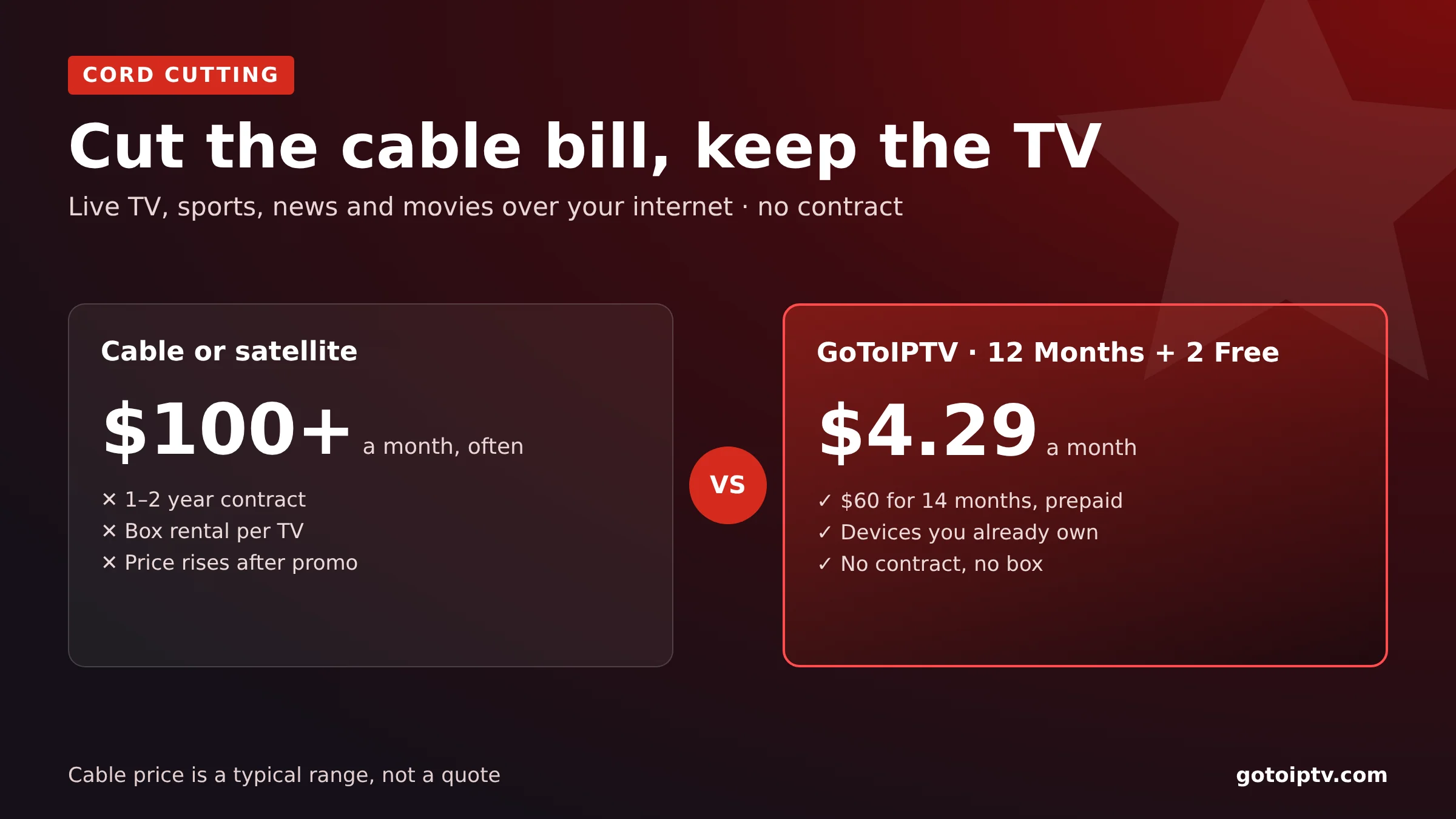
| Typical monthly cost | $60 to $150+ | $30 to $80+ for several apps | About $4.29 on the 12-month plan |
| Contract | Often 12 to 24 months | Monthly | None, prepaid |
| Equipment | Rented box per TV | Smart TV or stick | Devices you already own |
| Live channels | A fixed package | Few or none | 56,000+ |
| Movies and series | Extra fees | Split across apps | 150,000+ included |
| International channels | Expensive add-ons | Rare | Included |
| Needs internet | No | Yes | Yes |
IPTV vs Cable on Cost
This is where the difference is biggest. Cable often costs $60 to $150 or more each month once you add box rental, sports packs and fees, and the price usually jumps after the promotional period. A full year of GoToIPTV costs $60 for 14 months, about $4.29 a month, or you can start with 2 months for $12.
Over a year, many families save several hundred dollars, sometimes more than a thousand, by switching.
For a full breakdown of what you really pay, see our cheap IPTV guide with honest costs and free months.
Want every plan, line count and extra in one place? Our IPTV cost guide lists the price per month and per screen.
IPTV vs Cable: A Real Yearly Example
Here is a typical family that watches live TV, a few movie channels and some international programming:
| Item | Cable for 12 months | GoToIPTV for 14 months |
|---|---|---|
| Base package | $960 ($80 a month) | Included |
| Extra box for a second TV | $120 | 2-line plan $100 total |
| Movie and international add-ons | $240 | Included |
| Installation and fees | $60 | None |
| Total | About $1,380 | $100 for two screens |
Your numbers will differ, but the gap is usually large. That is why the IPTV vs cable question so often comes down to price.
IPTV vs Cable on Content
- Cable: a fixed channel package; premium channels and sports cost extra.
- Streaming apps: each app has its own catalogue, so you often need several.
- IPTV: GoToIPTV includes 56,000+ live channels and 150,000+ movies and series, with channels from every major country. Browse the IPTV channels list.
For families who want TV from home, in another language, IPTV is usually the clear winner, because international channels are included instead of sold as expensive add-ons.
Devices and Convenience
- Cable: usually one rented box per TV, with installation visits.
- Streaming apps: work on most smart devices.
- IPTV: works on Firestick, Smart TVs, Android TV, Apple TV, phones and computers. See our guides for Firestick, Samsung, Apple TV and PC and Mac.
Contracts and Flexibility
- Cable: long contracts and cancellation fees are common.
- Streaming apps: monthly, cancel any time.
- IPTV with GoToIPTV: prepaid for 1, 3, 6 or 12 months. No contract and no automatic lock-in. You can renew in a few clicks when you are ready.
Picture Quality and Reliability
Cable is extremely stable because it does not depend on your internet connection. Streaming apps and IPTV both use your broadband. With 25 Mbps or more and a wired connection, HD and 4K look excellent on IPTV. If you ever see pauses, our IPTV buffering fix guide explains the quick fixes. You can check your speed on Speedtest.
| Your internet | Best choice |
|---|---|
| Under 10 Mbps or unstable | Cable or satellite |
| 10 to 25 Mbps | IPTV in HD |
| 25 Mbps or more | IPTV in HD and 4K |
IPTV vs Cable for Sports Fans
Sports fans often pay the most for cable, because sports packs are expensive add-ons. With IPTV, sports channels from many countries are part of the same plan, and many events are available in HD and 4K. Use a cable connection for your main TV and the HD version of a channel during very busy events for the smoothest picture.
To see what is on today, our IPTV sports guide links to 7 daily schedules with start times in your own time zone.
IPTV vs Cable for Families With Roots Abroad
If your family wants TV from home, in Arabic, Hindi, Portuguese, French, Spanish or another language, cable usually means expensive international packs with only a handful of channels. With IPTV, channels from every major country are already part of the plan, so grandparents can watch their favourite news and series while the kids watch local channels on another screen.
What You Give Up When You Leave Cable
To be fair, cable still has a few advantages:
- It works without internet, so a broadband outage does not stop your TV.
- One bill and one remote for everything, with installation done for you.
- Recording boxes that store shows for months.
With IPTV you can get close: keep a small backup data plan on your phone, use the TV guide and favourites in your player, and choose a player with catch-up or recording features. For most homes with good internet, the savings far outweigh these points.
Hidden Costs to Watch For
- Cable: box rental, installation, regional sports fees, price rises after the promo, early termination fees.
- Streaming apps: yearly price increases, extra fees for more screens or 4K, add-on channel packs.
- IPTV: a player app may need a small activation fee, for example Hot Player lifetime activation, and an old TV may need a low-cost streaming stick.
How to Switch From Cable to IPTV in 5 Steps
- Check your internet speed on the TV you use most.
- Test IPTV for free with our 24-hour trial. It only needs your email.
- List your must-have channels and check the channel list.
- Choose your plan: one line per screen you want to use at the same time. See multi-screen plans.
- Cancel cable at the end of your contract to avoid fees, then return the rented equipment.
Our Verdict
For homes with stable internet, IPTV gives more channels and more on-demand content for far less money. Cable remains the safe choice only where the connection is weak.
Who Should Choose What?
- Choose cable if your internet is slow or unreliable.
- Choose streaming apps if you only watch a few shows on one or two services.
- Choose IPTV if you want lots of live channels and on-demand content in one place, on several devices, at a low price.
Licensing: An Honest Note
Cable companies and the big streaming apps license their content. IPTV is a technology, and services differ. Check that the way you watch follows the rules where you live, and ask any provider about their service before you buy. You can read more about how internet television works.
The Best Alternative to Cable TV: Short Answer
For most American homes, the best alternative to cable TV is a mix: a free antenna for local channels, plus one paid service for everything else, such as an IPTV plan or a live TV streaming app. That combination usually costs a fraction of a cable bill and has no contract.
Best Alternative to Cable TV With Local Channels
Local channels are the number one worry when people look for the best alternative to cable TV. The most reliable answer is an indoor or outdoor antenna, which picks up your local ABC, CBS, NBC, FOX and PBS stations for free after you buy it. Check what reaches your address on the FCC DTV reception maps. IPTV then covers national channels, sport, films and international TV.
- Antenna: local stations, free over the air.
- IPTV: national and international channels, plus a films and series library.
- Together: most of what cable offers, at a much lower monthly cost.
Free Alternative to Cable TV
In the IPTV vs cable debate, cost is where the gap is biggest. Want to pay nothing at all? A free alternative to cable TV is an antenna plus free ad-supported streaming apps. You will not get every channel, but for news, local programmes and a rotating choice of films and shows, it costs nothing each month.
Cheapest Alternative to Cable TV for Seniors
For seniors on a fixed income, the cheapest alternative to cable TV that still feels like cable is an antenna for local stations plus one simple service with a familiar TV guide. A Firestick with GoTo Player (Downloader code 1129312) shows channels in a guide much like a cable box. A 12-month IPTV plan works out at about $4.29 a month.
Best Alternative to Cable TV for Sports
For sport, IPTV vs cable comes down to stability. Sports fans need two things from any alternative to cable TV: the channels they follow and a picture that stays stable during live games. Use a cable or strong Wi-Fi, test during a big game before you commit and choose enough screens for game day.
How to Get Rid of Cable in One Weekend
- Friday: check your cable contract end date and early-exit fees.
- Saturday morning: install an antenna and scan for local channels.
- Saturday afternoon: set up a Firestick or Google TV with your new service.
- Sunday: test on your favourite channels, then call to cancel cable TV and keep your internet plan.
- Monday: return the cable boxes.
Do I Really Need Cable TV Anymore?
Most homes do not. Looking at IPTV vs cable for your own home: if your household mainly watches local news, a few favourite channels and films or series, the best alternative to cable TV covers all of it for less. Cable still suits homes that want one bill and one box for everything. Compare with our IPTV USA page.
IPTV vs Cable FAQ
Is IPTV cheaper than cable?
For most households, yes. A full year of GoToIPTV costs less than many single months of cable.
Is the picture as good as cable?
With a good connection, yes. HD and 4K look excellent; cable only wins on very slow or unstable internet.
Can I keep my streaming apps?
Of course. Many people keep one favourite app and use IPTV for live channels and the large movie library.
What about satellite TV?
Satellite works like cable in this comparison: very stable, but with dishes, receivers, contracts and higher monthly prices. Rural homes without good internet may still prefer it.
How many screens can I use?
One screen per line. Choose 2 or 3 lines if several people watch at the same time, which is still far cheaper than extra cable boxes.
Do I lose my local channels?
No. Local and national channels are part of the channel list, alongside international channels.
What if I do not like it?
Start with the free trial before you pay. If you have a problem after buying, contact support and read our refund policy.
What is the best option to get rid of cable TV?
An antenna for local channels plus one paid service, such as IPTV or a live TV streaming app, for everything else. Keep your internet plan.
What is the cheapest cable TV option for seniors?
An antenna (free local stations) plus a simple service with a TV guide on a Firestick. A 12-month IPTV plan is about $4.29 a month.
Do I really need cable TV anymore?
Most homes do not. An antenna and one or two services usually cover local news, favourite channels and films for much less.
Why are people getting rid of cable TV?
Rising bills, contracts, box rental fees and paying for channels nobody watches. Internet-based options are cheaper and more flexible.
Try IPTV Yourself
The best way to settle the IPTV vs cable question is to watch on your own TV. Start the free 24-hour trial and compare for a day.
Questions before you choose a plan? Our support team answers 24/7 on WhatsApp and by email.

One thought on “Best Alternative to Cable TV in 2026: IPTV vs Cable and Local Channels”